
 Nederlands
 Français
On Wednesday, 5 July 1939, the celebrated French liner Normandie prepared to leave Le Havre on one of her regular Atlantic crossings. Her route was one of the best known of the time: from the French coast to Southampton, and from there onward to New York. To travel on such a ship was to experience not merely transport, but one of the great rituals of transatlantic passage.
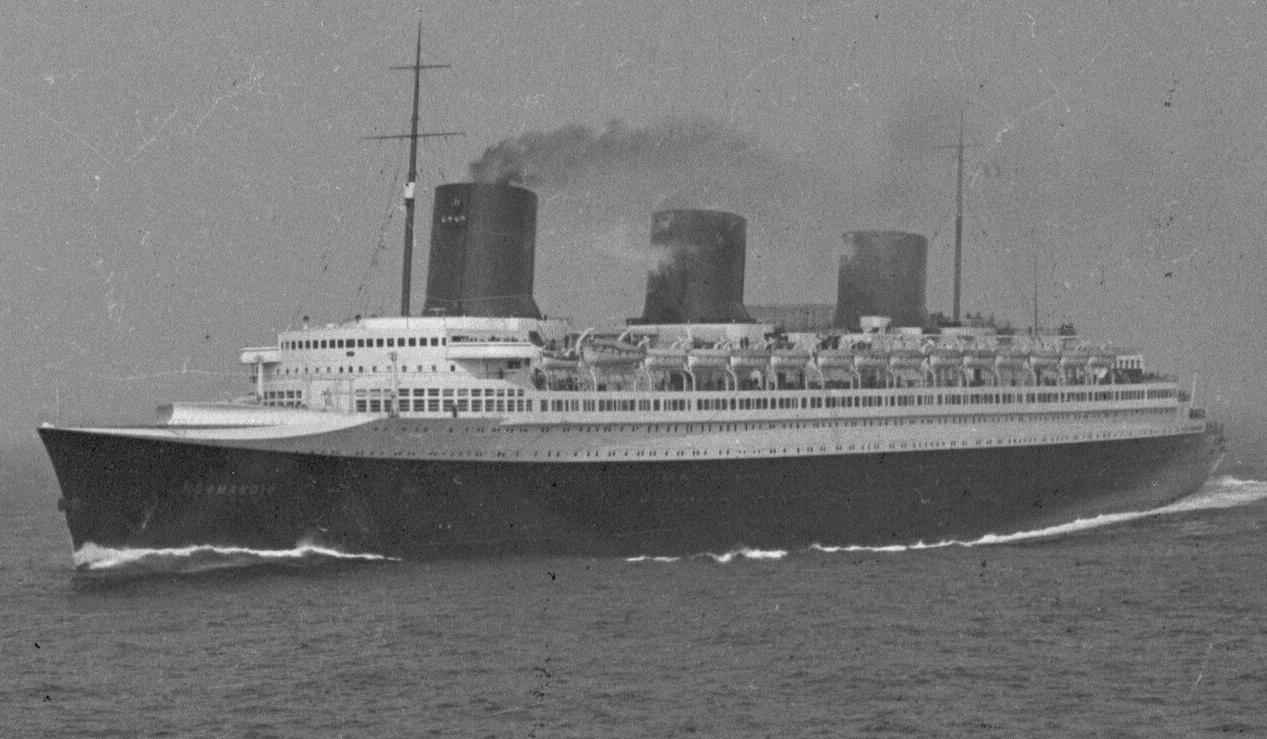
Among those embarking at Le Havre were Doctor Oswald Van Lantschoot and his wife. Their names place them within a moment of real historical tension. Europe in July 1939 was living through its final weeks of uneasy peace. For passengers boarding a ship for America, the journey could carry many meanings at once: travel, family reunion, professional duty, or perhaps the quiet desire to put an ocean between oneself and an increasingly uncertain continent.
A great ship and a large staff
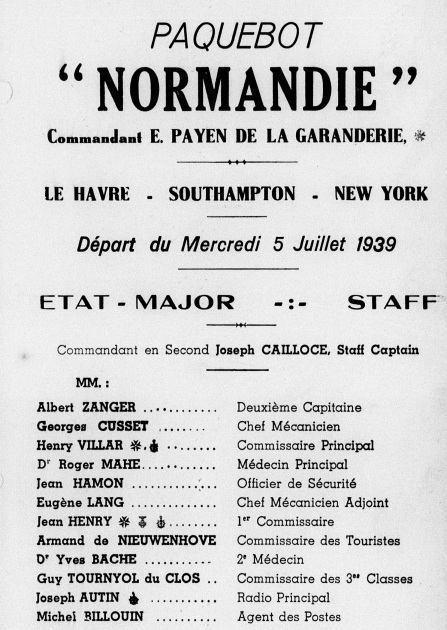
The passenger list was only one part of the story. The official ship record also reflected the extensive structure needed to operate so prestigious a vessel. The Normandie sailed under the command of E. Payen de la Garanderie, assisted by a large and carefully organized staff. The record names officers, engineers, doctors, commissaries, radio personnel, reception officers, baggage masters, hotel staff and kitchen leaders — each with a precise role in maintaining order, comfort and safety aboard one of the finest liners of her era.
Such a list reminds us that an ocean liner was in fact a floating city. Behind the polished public spaces stood a disciplined hierarchy: the second captain, chief engineer, principal commissary, ship’s doctor, security officer, tourist-class staff, postal agent, railway and tourism representative, reception staff, maître d’hôtel and chefs. All were necessary to keep the crossing running smoothly.
Southampton and the Atlantic crossing
After departure from Le Havre, the next stop was Southampton, long one of the major gateways for transatlantic travel. There additional passengers and baggage could be taken on board before the ship turned westward for the full Atlantic crossing. From there, the Normandie would proceed toward New York, carrying with her a cross-section of European and international society in the summer of 1939.
For Doctor Oswald Van Lantschoot and his wife, this route marked a decisive movement from the Old World toward America. Whether their journey was temporary or part of a larger transition, the surviving ship details preserve the essential outline: they boarded at Le Havre, they continued via Southampton, and they sailed toward New York aboard one of the most famous liners ever built.
A voyage just before the storm
Looking back, the timing of this crossing gives it an added poignancy. Barely two months later, Europe would be at war. The calm precision of the embarkation notice, with its elegant typography and formal staff list, belongs to the last chapter of peacetime Atlantic travel before the world was overtaken by conflict.
In that sense, the record is more than a shipping notice. It is a small window onto a vanished world: a world of great liners, ceremonial departures, and hopeful journeys westward. Through the mention of Doctor Oswald Van Lantschoot and his wife, it also becomes part of the wider history of the Van Landschoot family — linking family memory to one of the final great civilian crossings before the outbreak of the Second World War.
Source: Book Indexes for New York Passenger Lists, compiled 01/01/1906 - 01/04/1942 rolls 601-800 | T612d: New York. Passagierslijsten 9 mei 1939 - FS film #100345032 img 733-736