
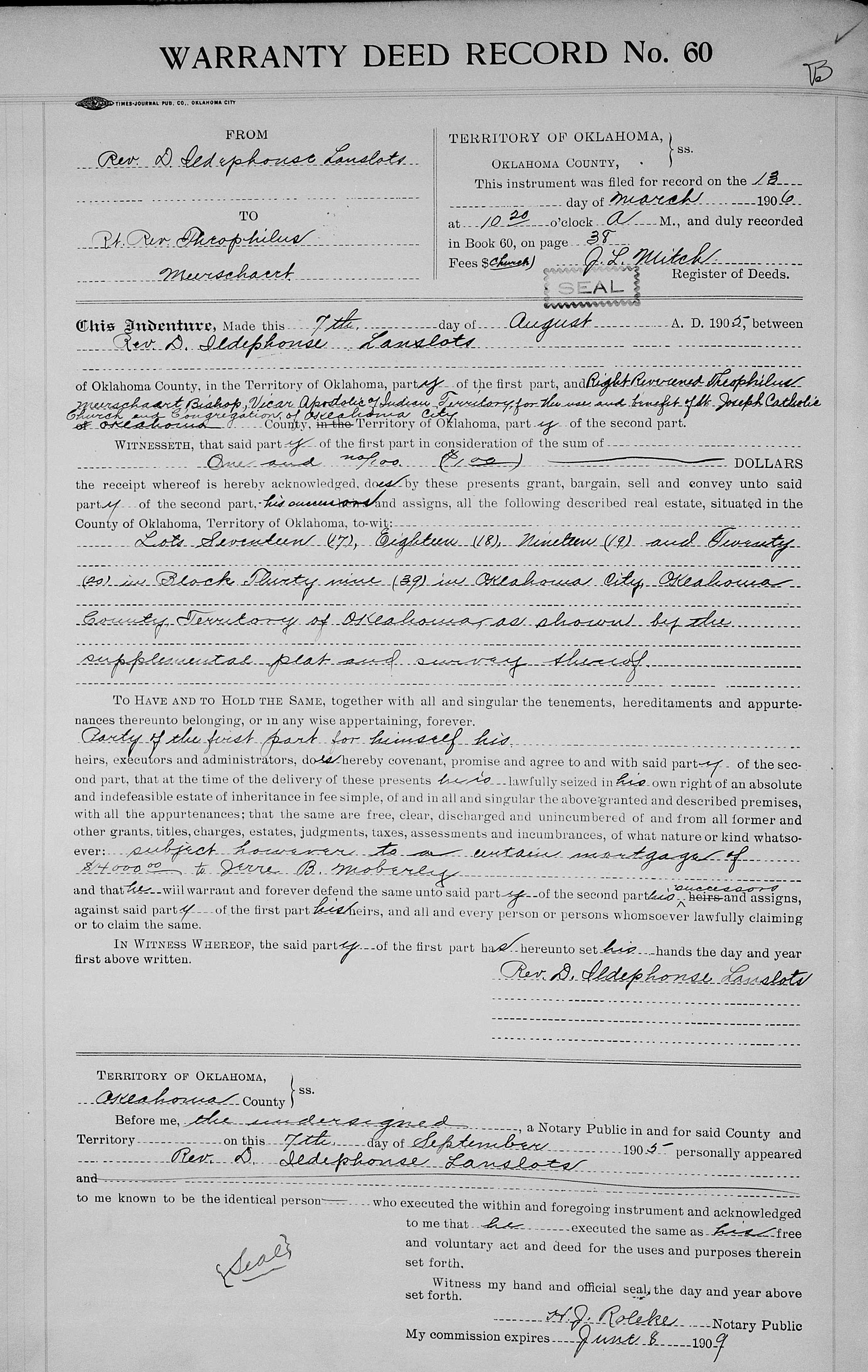
The deed states that on August 7, 1905, Reverend D. Ildephonse Lanslots, of Oklahoma County in the Territory of Oklahoma, executed a warranty deed in favor of the Right Reverend Theophilus Meerschaert. Meerschaert is identified in the document as Bishop and Vicar Apostolic of the Indian Territory, and the transfer was made expressly for the use and benefit of St. Joseph’s Catholic Church in Oklahoma City.
The consideration named in the deed was one dollar. Such a sum was clearly nominal, serving the legal form of the transaction rather than reflecting the practical value of the property itself. By this instrument, Lanslots granted, bargained, sold, and conveyed the land to Bishop Meerschaert and his successors, thereby placing the property within a clear ecclesiastical framework.
The Property Described
The land transferred consisted of Lots Seventeen, Eighteen, Nineteen, and Twenty in Block Thirty-Nine in Oklahoma City, Oklahoma County, Territory of Oklahoma. The deed adds that the description followed the supplemental plat and survey of the city, which gave the transfer its formal legal precision.
This was therefore no vague or symbolic act. It concerned clearly identified urban property, recorded in exact legal terms, and tied to a specific church purpose. The document shows that Lanslots was in a position to convey real estate that would serve the institutional life of St. Joseph’s Catholic Church.
Title and Obligation
As was customary in a warranty deed, Lanslots declared that he was lawfully seized of the property and that he had full right to convey it. He further warranted the title against lawful claims. At the same time, the deed openly noted that the property was subject to an existing mortgage of four thousand dollars. This mortgage was not concealed, but explicitly written into the record.
That detail matters. It reminds us that church property, like other property in a growing frontier city, could be burdened by financial obligations. The deed was therefore both a transfer of title and a statement of responsibility, carefully spelling out what was being conveyed and under what condition.
Formal Acknowledgment
The document also records that on September 7, 1905, Reverend Lanslots personally appeared before a notary public in Oklahoma County and acknowledged that he had executed the instrument freely and voluntarily for the uses and purposes set forth therein. This acknowledgment completed the legal formalities necessary for recording the deed.
The instrument was then officially filed for record on March 13, 1906, at 10:20 A.M., and entered in Book 60, page 38 of the county records. By then, what had begun as a church-related property transfer in 1905 had become part of the permanent documentary memory of Oklahoma County.
A Small Document with Larger Meaning
On its surface, the deed is a routine legal record. Yet behind its measured language stands a deeper reality. Reverend D. Ildephonse Lanslots appears here not merely as a priest named in passing, but as a man actively involved in securing property for Catholic use in Oklahoma City. The transfer to Bishop Theophilus Meerschaert, for the benefit of St. Joseph’s Catholic Church, reflects a moment when the structures of the Church were being rooted more firmly in place.
The document does not tell us everything. It does not explain the earlier history of the lots, nor does it dwell on the practical needs of the parish community. But it does preserve one clear fact: Lanslots played a direct role in the formal conveyance of church-related property in Oklahoma City in 1905, and that act was important enough to be carefully recorded in the public register.